Injured in the United States?

I represent Canadians and their families in serious cross-border injury cases.

If you have suffered a serious injury in the U.S., the legal system can feel unfamiliar, overwhelming, and financially risky. I help Canadians navigate that process with clarity, strategy, and a full understanding of how U.S. law, Canadian insurance benefits, and long-term care fit together.

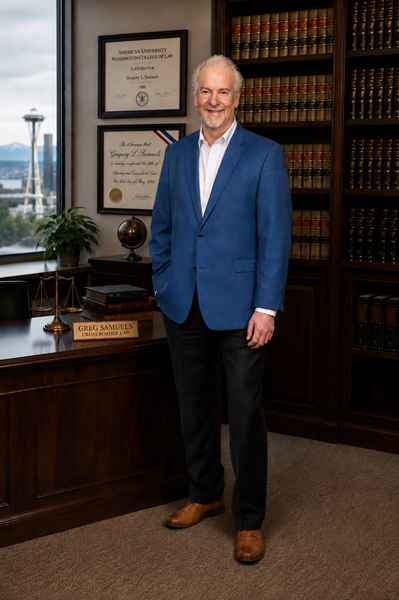
Greg Samuels

Dual U.S.–Canadian lawyer
Over 30 years representing Canadians injured in the United States
Licensed in Washington State and British Columbia

Request a Consultation

INTRO

If you’re here, something significant has happened.

You may be dealing with injuries, uncertainty about your future, and questions about how two different legal systems will affect your recovery.

I focus on helping Canadians navigate serious injury cases in the United States—particularly in Washington State—while accounting for the realities of Canadian insurance benefits, and long-term care.

I’m Greg Samuels, founder of Cross Border Law.

For more than three decades, I’ve represented Canadian citizens and their loved ones who were seriously injured or killed in the United States. I’m licensed and experienced on both sides of the border, with a practice that has taken me into courtrooms across Washington State, including federal court.

Over time, I’ve moved toward a more focused approach. I take on a small number of significant cases each year and work closely with a national team of experienced lawyers, experts, and jury consultants. This allows us to give each client the attention and strategic thinking their situation requires, and to tap into the resources necessary to prepare serious cases properly, including experienced co-counsel, experts, investigators, and jury consultants to ensure that cases can be prepared and presented properly.

My clients are often facing life-changing injuries. The work is serious, and so is my commitment to doing it properly.

WHAT MAKES THESE CASES DIFFERENT

Cross-border injury cases are not just larger versions of ordinary claims. They involve a different set of challenges:

  • Determining where the case should be heard
  • Navigating U.S. liability law and trial procedure
  • Coordinating with Canadian insurance systems (including ICBC and underinsurance)
  • Structuring recovery to account for long-term care across borders

Handled correctly, these cases can significantly affect a person’s financial security and quality of life. Handled poorly, important opportunities can be lost.

ABOUT GREG SAMUELS

A Cross-Border Practice, Built Over Time

I set out to build a niche practice. I called it “Cross Border Law” in 1995.

Early in my career, I began representing Canadians who had been injured in the United States—often in Washington State. What started as a handful of cases became a steady focus, and eventually a deliberate practice, with several associates and paralegals, built around the complexities of cross-border injury litigation.

Those cases are different. They require an understanding not just of U.S. law, but of how it interacts with Canadian insurance benefits, and long-term care realities. They also tend to matter a great deal to the people involved.

That combination is what has kept me here.

Experience That Spans Both Sides of the Border

I am a dual American and Canadian lawyer. I’m also a dual American and Canadian citizen, living in both countries and understanding the attitudes and opinions which shape jurors’ decisions.

I’ve been a member of the Washington State Bar since 1990 and the Law Society of British Columbia since 1994. My work has taken me into courtrooms across Washington—both state and federal courts—handling serious injury, wrongful death and product liability claims.

Over the years, I’ve tried many cases, resolved others through negotiation, and worked alongside a wide range of experts—medical, engineering, and financial—to properly present the full impact of an injury to a jury.

Experience matters in these cases. But so does judgment—knowing when to push, when to step back, and how to structure a case so that it achieves the right outcome for the client.

A More Focused Practice

At this stage of my career, I’ve chosen to work differently.

I limit my practice to a small number of significant cases each year. That allows me to stay closely involved, to think strategically, and to work with a trusted team across both countries.

These cases often involve life-changing injuries. They deserve time, attention, and care. I don’t believe they can be handled well any other way.

How I See My Role

Clients come to me at difficult moments.

They are often dealing with injuries, uncertainty, and decisions that will affect them for years to come. My role is to bring clarity to a complicated situation and to guide the legal process in a way that supports their recovery—financially and otherwise.

That doesn’t always mean being aggressive for the sake of it. It means being deliberate, prepared, and steady when it matters most.

What Matters to Me

Over the years, I’ve stayed in touch with many of my former clients. Some have become friends. That tends to happen when people go through something difficult together and come out the other side.

The cases themselves matter. But the people involved matter more.

Education and Credentials

  • Tulane University — B.A. (English)
  • American University, Washington College of Law — Juris Doctor
  • Legal training completed at the University of British Columbia, Allard School of Law
  • Washington State Bar — since 1990
  • Law Society of British Columbia — since 1994

Published Articles

Wrongful Death and Survival Actions in Washington State: Comparing Benefits from a Canadian Perspective, The Verdict, April 2005.
Extending American Products Liability Jurisprudence to Canadian Plaintiffs – Lessons from a Seven Year Battle, The Verdict, April 2004.

Outside the Office

My sport is mountain biking—I do it for fun and exercise, and a way to see the world. I also love live music of many genres.

If You’re Reaching Out

If you’re dealing with a serious cross-border injury situation and considering your options, I’m available to speak with you.

We’ll keep the conversation straightforward. If I can help, I will. If I can’t, I’ll try to point you in the right direction.


SELECT CASES

Representative matters. Results depend on the facts of each case.

Serious Motor Vehicle Collision — Washington State

An older Canadian gentleman was riding as a passenger in his son’s vehicle stopped in the lineup at Canadian Customs, when they were struck from behind by a high-speed driver. The collision caused him catastrophic injuries, including brain and spinal trauma, resulting in permanent partial paralysis.

Multiple parties denied responsibility, (1) the driver blaming his intoxication on ether fumes among the products he was delivering to a tavern, (2) the tavern that probably over-served him alcohol, and (3) a commercial employer directing the driver’s delivery trip and claiming that the delivery to this tavern constituted a “frolic” and not simply a “detour.”.

We conducted a detailed investigation, coordinated medical and liability experts, and navigated legal issues spanning both U.S. and Canadian law.

The case resolved for the full combined policy limits available, almost $5 million USD, ensuring that the family had the financial resources necessary for long-term care.

Defective Product / Tire Failure — Washington Trial

A Canadian family was involved in a single-vehicle rollover caused by a tire failure on a Washington highway. Several family members were ejected from the vehicle and suffered serious, life-altering injuries.

Both the driver and the tire manufacturer blamed the other, and cross-border insurance complications ensued, including multiple rounds of litigation in both Washington and British Columbia.

After an eight-week trial, the Washington jury returned a verdict of $9.1 million, one of the largest of its kind at the time, reflecting the severity of the injuries and long-term impact on the family.

We then pursued underinsurance claims against ICBC, re-litigating the damages component of these claims, as well as insurance bad faith claims which were subsequently resolved for a confidential sum.

Cross-Border Insurance Recovery (Bad Faith / Underinsurance)

A Nevada resident was seriously injured while traveling in a Washington-insured vehicle in British Columbia. She received advice from U.S. counsel to resolve the case quickly for available limits of $200,000. She sought a second opinion from a lawyer who was smart enough to recognize the cross-border component and called me.

We pursued the concept of “depecage” to argue that certain claims be governed by specific jurisdictions connected to the facts and issues in the case, including punitive damages allowed under Washington state law, despite that jurisdiction having little connection to the accident. Using that strategy, we were able to resolve the case for $1.6 million, significantly improving the client’s long term financial position.

Jurisdiction Strategy — U.S. vs. Canada

In a case that received national media attention after two recent high school graduates were killed when their natural gas tank exploded while stopped at Canadian Customs, just north of the actual border, it was revealed at a subsequent manslaughter trial that the defendant driver was driving faster than 100mph while hallucinating after taking the diet supplement “Ephedra.” Incredibly, the driver was completely uninjured and unaware that she had caused a fatal collision.

We assisted the estates of the two young women as well as the occupants of two other vehicles involved, against the driver and against the manufacturer and distributor of Ephedra. Key legal issues turned on whether the matter would proceed under Canadian or U.S. law. We successfully established that the case should proceed in Washington, based on “substantial connections” to that jurisdiction aside from the location of the crash, allowing the matter to resolve for substantially more than would have been available under Canadian damages law. The case and its outcome were featured on the news program, Good Morning America.

Canadian Doctor’s Minor Impact Collision in Seattle Causing Major Life Disruption

Our client was a Canadian neurosurgeon whose career depended on precise manual dexterity. After a minor rear-end collision on Interstate 5 in downtown Seattle, he suffered a nerve root impingement that hindered him from performing the most delicate procedures that defined his work and identity. The case required careful evaluation of not only financial loss, but also the profound personal impact of losing a vocation built over decades.

After extensive discovery and negotiation against a $5M USD insurance umbrella, the matter resolved on confidential terms that reflected both the economic and human dimensions of that loss. While preparing each case for trial, a disciplined negotiation strategy is necessary to ensure that the full value of a claim is recognized, always aligned with a client’s goals and best interests, in this case changing the case focus from strict income loss to personal loss, including curtailing the doctor’s ability to save lives in his work, to work puzzles with his wife, and to play guitar with his kids.

HOW I WORK

I no longer handle a high volume of cases.

Instead, I focus on a limited number of serious matters each year. This allows for:

  • Careful case selection
  • Strategic planning from the outset
  • Direct involvement throughout the process
  • Coordination with trusted experts across both countries

These cases often take time. My role is to move them forward thoughtfully and deliberately, with your long-term interests at the center.

FEES

I work on a contingency basis.

That means:

  • You do not pay legal fees up front
  • My fee is a percentage of the recovery
  • If there is no recovery, there is no fee

We’ll explain the structure clearly at the outset so you understand exactly how it works.

CONSULTATION

If you or a family member has been seriously injured in the United States, I’m available to speak with you. Consultations are straightforward and confidential. If your case is a fit, we’ll explain the process and next steps clearly.